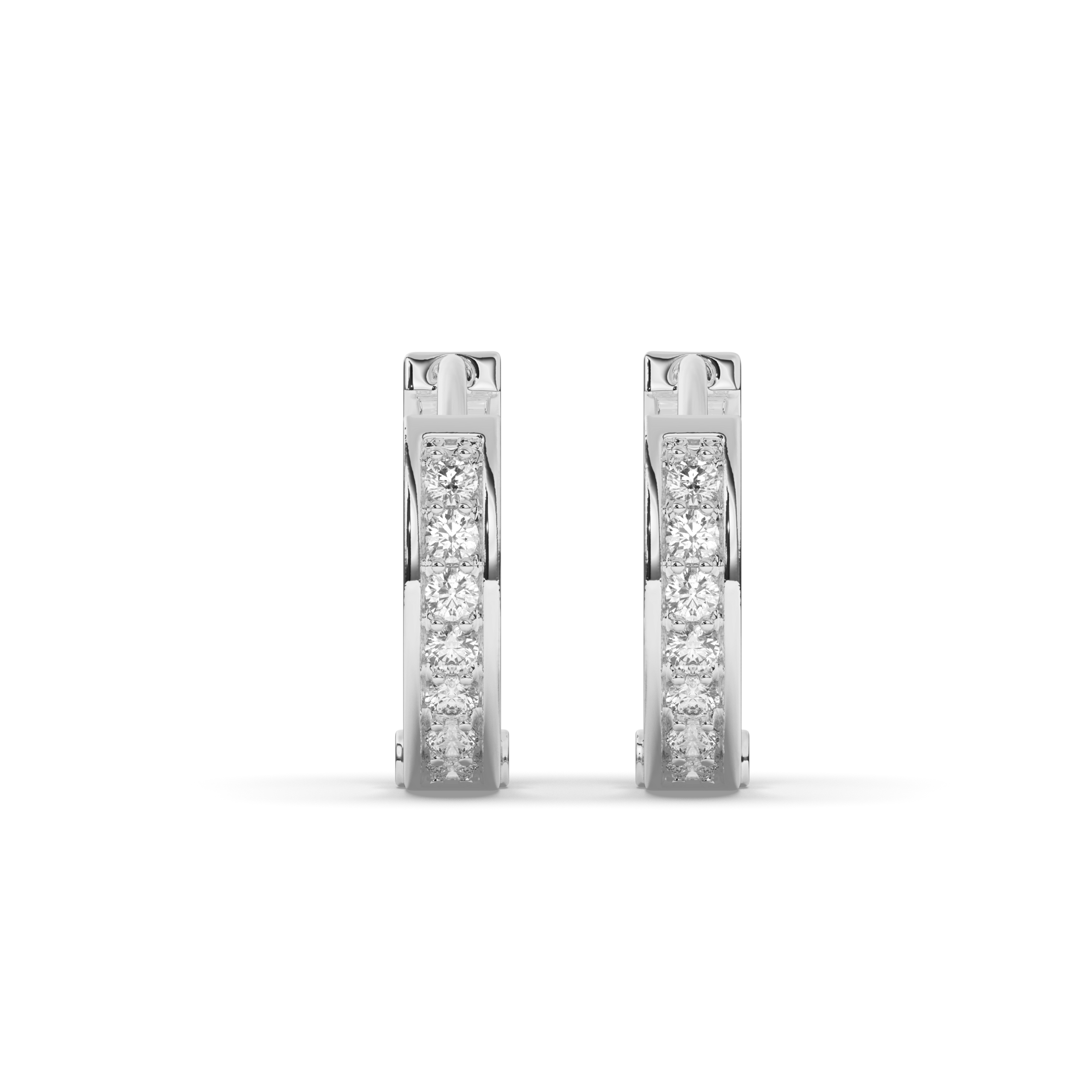
Shared-Prong vs U-Prong Eternity Ring: Which Setting Is Better?
Shared-prong and U-prong eternity rings are both designed to reveal as much diamond as possible. Shared-prong settings create a refined, continuous row with minimal metal between stones, while U-prong settings open the side profile and allow each diamond to sit in a sculpted U-shaped cradle.
Choose shared-prong if you want a low-metal, continuous diamond line with a classic face-up appearance. Choose U-prong if you prefer a more open side profile, stronger individual stone definition and maximum light exposure around each diamond. Shared-prong looks seamless from above; U-prong looks more sculptural from the side.
Shared-Prong vs U-Prong: Quick Comparison
Seamless face-up sparkle
Adjacent diamonds share prongs, reducing visible metal and creating a continuous line of brilliance.
Open, sculptural brilliance
Each diamond sits between curved U-shaped supports, leaving more of the side profile visible.
| Feature | Shared-Prong | U-Prong |
|---|---|---|
| Prong structure | Neighbouring diamonds share prongs | Each diamond is supported by U-shaped side supports |
| Top view | Continuous, refined diamond row | Distinct diamonds with strong separation |
| Side view | More restrained and compact | Open, sculptural and highly visible |
| Light exposure | Excellent from above and between stones | Excellent from above and through the sides |
| Metal visibility | Very low between diamonds | Visible curved supports from the side |
| Comfort | Can be smooth when low-set | May feel more textured with larger stones |
| Best for | Classic, elegant and seamless sparkle | Bold, open and luxurious diamond presentation |
What Is a U-Prong Eternity Ring?
A U-prong eternity ring places each diamond inside a curved U-shaped metal cradle when viewed from the side.
This structure exposes more of the diamond pavilion and side profile, creating a highly open and luxurious appearance. Each stone reads more distinctly than in many shared-prong designs.
U-prong settings are especially striking with medium to larger diamonds because the open supports emphasise each stone's shape and depth.
Open side profile
The U-shaped structure reveals more of each diamond.
Strong stone definition
Each diamond appears more individually framed.
Luxury presence
The sculpted profile creates a premium statement look.
Eight Important Differences
Shared vs individual support
Shared-prong uses common holding points; U-prong uses distinct U-shaped cradles.
Seamless vs defined
Shared-prong creates continuity; U-prong gives each stone stronger individuality.
Compact vs open
U-prong reveals more diamond depth and profile.
Minimal vs sculptural
Shared-prong hides more metal from above; U-prong displays its curved structure.
Lower vs more dimensional
Shared-prong can often sit lower, while U-prong may require more vertical space.
Refined vs textured
Larger U-prong diamonds may feel more noticeable between the fingers.
Shared points vs open cradles
Each design has different inspection and cleaning areas.
Classic vs dramatic
Shared-prong feels timeless; U-prong feels bolder and more architectural.
Which Setting Sparkles More?
Both settings are designed to maximise sparkle, but they do so differently.
Shared-prong produces a continuous ribbon of brilliance because the diamonds sit close together and the prongs are visually reduced from above.
U-prong exposes more of each diamond from the side, creating stronger depth, scintillation and individual stone presence.
Continuous face-up sparkle
Best when you want the row to look seamless and refined.
Open three-dimensional sparkle
Best when you want each diamond to feel individually showcased.
Which Setting Is More Secure?
Security depends on prong thickness, diamond fit, craftsmanship and maintenance rather than the setting name alone.
In a shared-prong design, one worn or damaged prong may affect two neighbouring diamonds. In a U-prong design, each stone receives more individual side support, but the open profile can remain vulnerable to strong impact.
| Security factor | Shared-Prong | U-Prong |
|---|---|---|
| Support pattern | Prongs secure adjacent stones together | Each stone sits in its own U-shaped support |
| Potential weak point | One damaged shared prong may affect two stones | A bent individual support may loosen one stone |
| Side protection | Moderate | Open but individually structured |
| Impact resistance | Strong when low and well proportioned | Strong when adequately built, but open sides remain exposed |
| Inspection priority | Check every shared contact point | Check every U-shaped cradle and upper prong tip |
Side Profile and Ring Height
Shared-prong rings often create a more compact side profile because the support structure is visually concentrated between stones.
U-prong rings are intentionally more open. The curved U forms create a recognisable side-view pattern and may sit slightly higher, especially with larger diamonds.
Compact elegance
Ideal for a refined stack and lower-profile look.
Sculptural openness
Ideal when the side view should feel as luxurious as the top view.
Check band contact
Match the height and edge profile with the engagement ring to reduce rubbing.
Which Setting Is More Comfortable?
Shared-prong settings can feel slightly smoother and more compact, particularly when the diamonds are small and the ring is set low.
U-prong settings may feel more noticeable between the fingers because the side supports and diamond girdles are more exposed. The effect becomes stronger as diamond size increases.
Refined and compact
Often the easier choice for close stacking and daily wear.
More dimensional
Offers a luxurious profile but may feel more textured with larger stones.
Which Setting Is Easier to Maintain?
Shared-prong rings have very small contact points between neighbouring stones. These areas should be checked for wear, lifting or movement.
U-prong rings are more open from the side, which can make cleaning easier, but each individual cradle and prong still needs careful inspection.
| Maintenance area | Shared-Prong | U-Prong |
|---|---|---|
| Cleaning access | Good, but spaces between stones can be narrow | Excellent side access because of the open profile |
| Prong inspection | Focus on shared contact points | Focus on each individual U support and tip |
| Residue collection | May collect between tightly spaced diamonds | Open sides help release residue more easily |
| Professional checks | Important for shared wear points | Important for individual cradles and open edges |
Read the Pear Jewels Jewellery Care Guide for ongoing cleaning and protection advice.
Best Diamond Shapes for Each Setting
| Diamond shape | Shared-Prong | U-Prong |
|---|---|---|
| Round | Excellent for a seamless classic row | Excellent for open brilliance and individual definition |
| Oval | Creates elegant continuity when precisely matched | Highlights the elongated side profile |
| Emerald | Works with careful spacing and secure corner support | Beautiful for a bold architectural look |
| Asscher | Creates refined geometric rhythm | Displays the step-cut depth from the side |
| Cushion | Produces a soft, romantic diamond line | Emphasises rounded corners and depth |
| Princess | Requires precise corner protection | Can create a striking geometric side view |
| Radiant | Combines continuous brilliance with angular structure | Shows strong depth and clipped-corner character |
| Mixed shapes | Possible in custom rhythmic layouts | Best when each stone receives a tailored cradle |
Compare silhouettes in the Diamond Shapes Guide.
Which Setting Works Better for Full or Half Eternity?
Shared-prong practicality
A compact profile can reduce bulk around the complete finger.
U-prong luxury
Creates exceptional sparkle but may feel more noticeable underneath.
Both work beautifully
The smooth underside reduces comfort concerns for either setting.
Shared-Prong and U-Prong Pros & Cons
Pros and considerations
Minimal visible metal
Continuous face-up sparkle
Classic and versatile appearance
Can create a compact profile
One prong may support two stones
Tight spaces require careful cleaning
Shared wear points need inspection
Less dramatic from the side
Pros and considerations
Open side light exposure
Strong individual stone definition
Luxurious sculptural profile
Easier side access for cleaning
May sit higher
Can feel more textured between fingers
Open sides remain impact-exposed
More visible structure from the side
Should You Choose Shared-Prong or U-Prong?
Shared-Prong vs U-Prong Eternity Ring FAQs
What is the difference between shared-prong and U-prong settings?
Shared-prong settings use common prongs between neighbouring diamonds. U-prong settings place each diamond inside a curved U-shaped support visible from the side.
Which setting sparkles more?
Shared-prong creates stronger face-up continuity, while U-prong exposes more of each diamond from the side.
Which setting shows less metal?
Shared-prong generally shows less metal from above because adjacent diamonds share holding points.
Which setting has the more open side profile?
U-prong has the more open and sculptural side profile.
Which setting is more secure?
Both can be secure when properly engineered. Security depends on prong thickness, stone fit, craftsmanship and regular inspection.
Can a shared prong affect two diamonds?
Yes. Because one prong may help secure neighbouring stones, damage to that point can affect both.
Does U-prong support each diamond individually?
Yes. Each diamond typically sits within its own U-shaped side cradle.
Which setting is more comfortable?
Shared-prong can feel more compact, while U-prong may feel more noticeable with larger diamonds.
Which setting is better for a full eternity ring?
Shared-prong often offers a more compact full-circle profile. U-prong offers greater side brilliance but may feel more textured underneath.
Which setting is better for a half eternity ring?
Both work beautifully. Shared-prong looks seamless, while U-prong gives each upper diamond stronger definition.
Which setting is easier to clean?
U-prong usually provides more open side access, although both require careful brushing and periodic professional cleaning.
Which setting snags less?
A low, well-finished shared-prong design may snag less. However, the final result depends on prong shape and setting height.
Does U-prong sit higher?
It often does, especially when larger diamonds require deeper U-shaped supports.
Can shared-prong settings be low profile?
Yes. Shared-prong designs can be engineered with a compact and refined side profile.
Which setting is better for Round diamonds?
Both are excellent. Shared-prong creates classic continuity, while U-prong emphasises each Round diamond individually.
Can Oval diamonds be used in U-prong eternity rings?
Yes. U-prong can beautifully reveal the elongated side profile of Oval diamonds.
Can Emerald-cut diamonds be shared-prong set?
Yes, but corner support, stone matching and spacing must be carefully engineered.
Which setting suits larger diamonds?
U-prong is especially attractive for larger stones because it highlights each diamond's depth and shape.
Which setting is more classic?
Shared-prong is generally considered the more classic and understated option.
Which setting looks more luxurious?
Both can look luxurious. U-prong tends to appear more sculptural, while shared-prong appears more seamless and refined.
Can either setting be resized?
Half eternity versions may offer some resizing flexibility. Full eternity versions are usually difficult to resize regardless of prong style.
How often should prongs be inspected?
Periodic professional inspection is advisable, especially for rings worn daily or set with larger diamonds.
Should I remove an eternity ring during exercise?
Yes. Heavy lifting and equipment contact can bend prongs or damage diamond edges.
Can Pear Jewels customise either setting?
Yes. Pear Jewels can personalise diamond shape, size, coverage, prong style, band width and precious metal.
Where can I learn more about eternity rings?
Visit the Pear Jewels Eternity Rings Explained guide.